



Me when I spread misinformation
Turns out I misremembered things (oops), and the in-game recipe goes vinegar first, not sugar first. The recipe here still makes imonamasu fine, but if you're really interested in making it as authentic to in-game as possible, maybe try adding the vinegar first and the sugar at the very end. Well, it's not like I tried making the namul-style or the marinade-style imonamasu here either, though, so...
Yuritopi-Blog! #1: Imonamasu Showdown
Published: 10/21/25
Oooo~ It’s October, which means it’s the perfect time for spirits—or more specifically, kindred spirits! Well, yuri’s always in season, of course, but with Halloween also comes another special occasion: the anniversary of Sachi-san and Megumi moving on from this world. So, in celebration, I’m unleashing my inner Yuna and trying my hand at making Sachi-san’s favorite dish, imonamasu!
Now, this is where I’d say I’ve already tried making this before—twice, in fact—I actually failed horribly both times. During the first attempt, I made a mistake of assuming “vinegar” in a Japanese recipe referred to white vinegar (turns out it was actually rice vinegar, duh), but during the second time, not only did I undercook it, I accidentally used half the intended amount of seasoning because the “medium-sized” potatoes I was using were double the size of Japanese ones. Such are the nuances of Japanese recipes, I suppose...
To make up for my failures, I’ve done plenty of research to assemble the most comprehensive and accurate English-language recipe for imonamasu out there! But there’s one big problem: all the seasonings in the recipes I’ve looked at are different. Some use more sugar, some use more vinegar, some add the sugar first, vinegar first, some add chili peppers—anyways, it’s complicated. So, to solve this, we’re going to have a showdown, pitting three recipes against each other to see which one comes on top! For simplicity’s sake, we’ll just be using the basic seasonings—sugar, vinegar, and salt, no added ingredients—and adjusting their proportions based off of the recipes I’ve found. We’ll be inviting a special guest to help us out, too!
Anyways, let’s begin!
Of course, if you don’t want to read through all this nonsense and just want the recipe, you can just click this link here to jump to it:
(If you’re just some random person that just wanted an imonamasu recipe and has no clue what this game even is, I’m sorry I’m forcing you to deal with all this...)
Note: This recipe takes at least two hours to prepare (you’ll need to soak the potatoes for a while to remove the starch), so if you’re wanting to make this, make sure you start prepping well in advance.
So, to start off, what’s imonamasu, anyways? Well, as a hint, the name literally means “raw potato + vinegar”, but more specifically, it refers to thinly sliced, partially cooked strips of potato, pickled in a sweetened rice vinegar. Raw potato... doesn’t really seem that appetizing, honestly, but this is for Sachi-san’s sake, so! Anyways, the ingredients we need are pretty simple: just potatoes, rice vinegar, sugar, and salt.
So let’s start cooking. We’re going to start with a lot of boring talk about potato prep, so if you’re not interested in making imonamasu yourself and want to skip all that, just click this link here:
For our ingredients, the typical four-serving recipe for imonamasu calls for two medium danshaku (Irish Cobbler) potatoes, but you probably won’t be able to find them unless you live in Japan; you can substitute them with about 200-300g of any floury type of potato available in your area. I used one medium/medium-large russet, which is apparently a good substitute[1], but if you’re in the UK, Maris Pipers seem to be good as well[2]. Four servings is really a lot though (especially because of the rawness of the potatoes), so I’d recommend only making one or two servings max.
On top of the potatoes, we’ll also need unsweetened rice vinegar, sugar, and salt, as well as a large bowl of cold water to soak the potatoes overnight and a colander for straining.
Before we talk prep, I’d like to say that a video recipe for imonamasu is available here (albeit in Japanese): https://www.youtube.com/watch?v=R9GJnrohYWM. The recipes we’re trying here are all different from the one in the video, and the auto-dubbing of the video is blatantly incorrect a lot of the time, but the general steps are the same, so it's a good reference. I did use it as a reference for this article too, but there are still some tips in this article that aren’t in the video, so I’d still recommend reading through this if you’re planning to make imonamasu.
Anyways, to start, we’ll first start prepping our potatoes at least two hours before cooking but preferably the night before. Right now, we just need our potatoes and our bowl. With the bowl of cold water on hand, we’ll first peel our potatoes, trim off and discard the ends of them (since they’re too thin to julienne), and then cut a flat spot on the side of each potato to prevent them from rolling. Afterwards, we can thinly slice each potato (if you’re using a larger potato, wide-ways, not long-ways) to the width of about half a matchstick[3]. When you’re cutting off a piece of the potato to create a flat spot, cutting it gradually in half-matchstick slices will let you easily julienne the piece you cut off later as well. As you slice, make sure to drop the cut slices into the bowl of water immediately to rinse the starch off, as the potatoes will start oxidizing otherwise. Then, take the slices out in batches, stacking the slices on top of each other and julienning them to the same half-matchstick width, placing them back into the water afterwards.
Now, although you can use one, it’s not recommended to use a mandolin for the slicing as it’ll make the potatoes less crisp. I’m guessing it’s related to how thin the potato slices we’re using are, but apparently, unlike a knife, a mandolin crushes the cells of the potatoes while cutting, which changes the texture.[4]
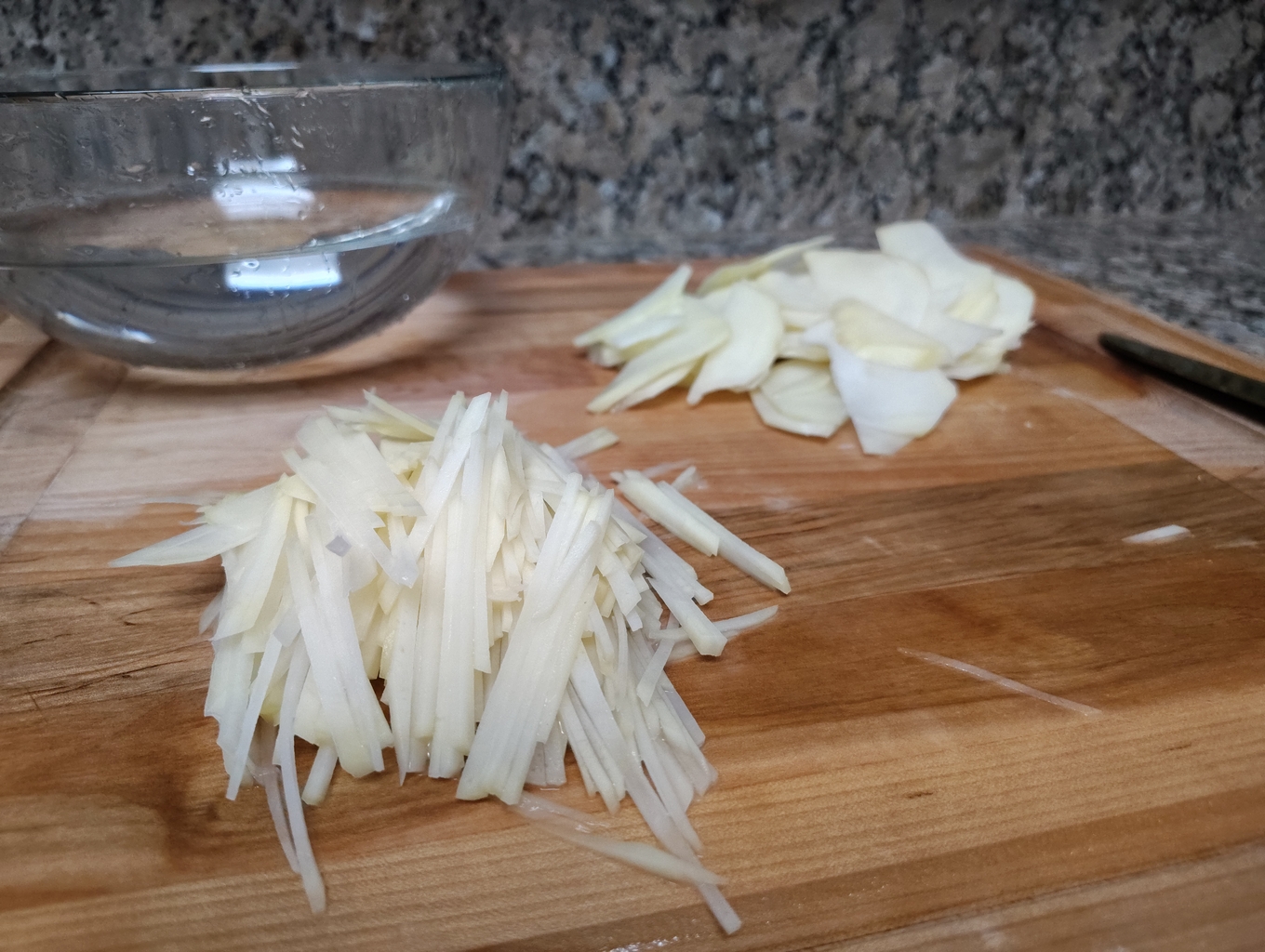
Now that we’re done cutting, we’ll rinse the julienned potatoes a few times to remove the starch (until the water is clear), and then soak them in the refrigerator for at least two hours to help remove any remaining starch. It’s best to soak overnight, but if you’re soaking for a shorter time, you should change out the water every so often to better remove the starch.
After the potatoes are done soaking, we’ll strain them thoroughly, making sure to shake off any excess water. They should be a lighter white color now that they’ve lost all their excess starch. Of course, be careful to not leave the strained potatoes out for too long before cooking or else they'll start to oxidize.
Anyways, now that the potatoes are prepped, we just need to get our seasonings ready before we finally start cooking. We’re testing out three different seasoning methods based on recipes I found online: one with a stronger vinegar seasoning[5], one with a lot more sugar[6], and one that’s still sugar-forward but more balanced[4]. Because of that, we’re prepping three different measurements each of vinegar, sugar, and salt here—the specific amounts we’re using are available in the recipe section below. And, this is optional, but if you have one, you can bring out your assistant to help you cook now as well. I have mine here. Say hello, Sachi-san!
Sachi: Hello!
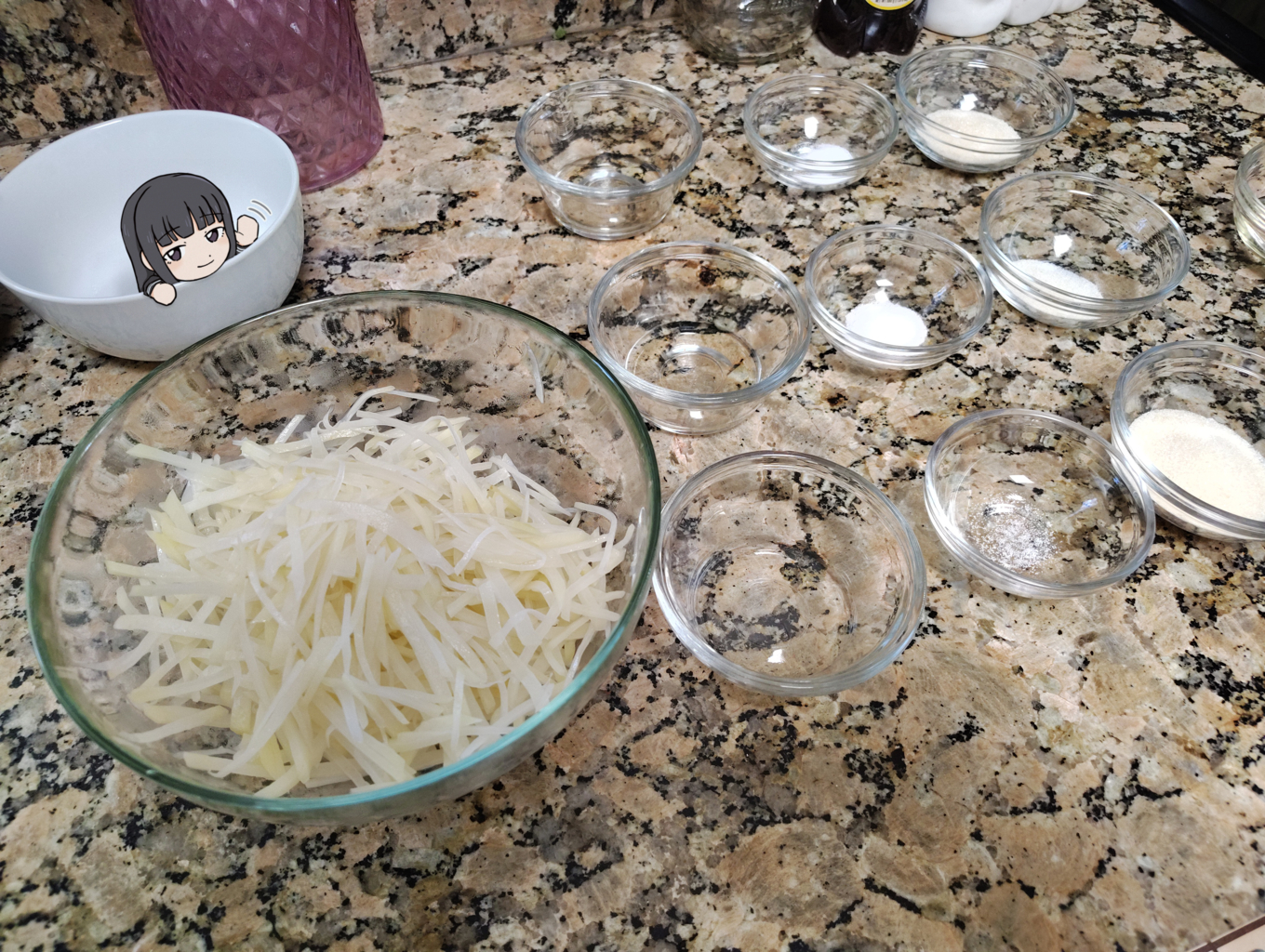
We'll start by putting our pan on medium heat and adding a good amount of oil—we’re making four servings here, so about 3 tbsp in our case. You’ll want to start cooking the potatoes until they start turning soft, more flexible, and partially translucent, making sure they don’t get cooked through; you want them to still be somewhat raw at the end. Stir them constantly to make sure they don’t brown, and if you’re worried about overcooking them, you can taste a piece every so often to make sure it’s still raw (having a completely raw stick of potato on hand can help make sure you’re not undercooking it, either). Personally, though, as long as you’re careful, I don’t think you really need to worry about overcooking the potatoes; they stay raw for a lot longer than you’d think, and you can always cut the heat for a bit while you're adding the seasoning. However, unless you want to fling potatoes everywhere, I’d recommend using a larger pan than we used here.
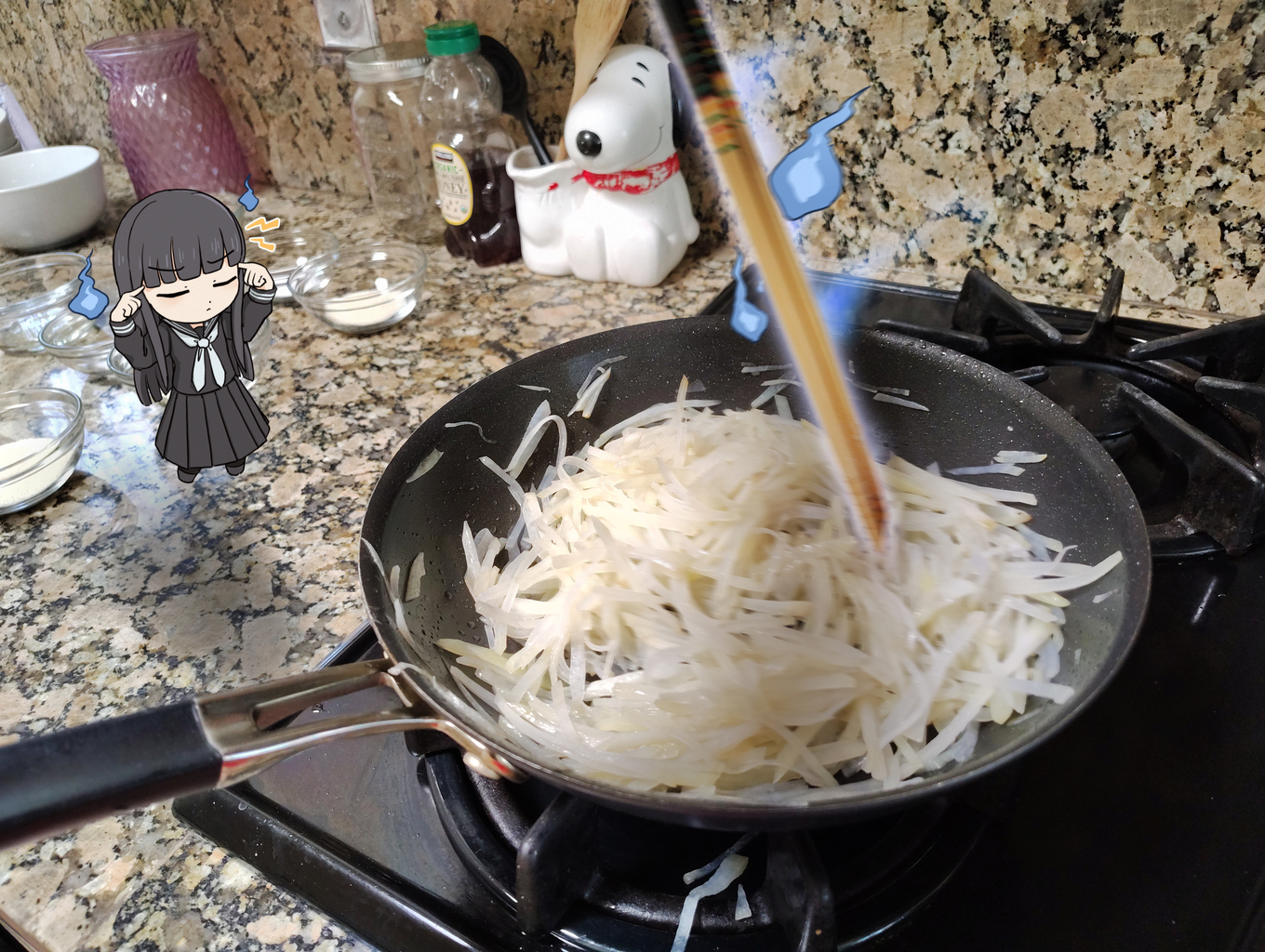
Once the potatoes start turning translucent, it’s time to add our seasoning. Like the game says, sugar goes first, followed by salt, then vinegar; otherwise, the sugar won’t stick. First, add the sugar, and then mix to make sure all the potatoes are coated, stirring constantly so the sugar doesn’t burn. The sugar should melt down to a liquid. Then add the salt, mix until it dissolves, and then finally mix in the vinegar.
After seasoning, there should be some liquid in the pan, mostly from the molten sugar (so the vinegar-forward version shouldn’t have much; you can probably skip this step in that case). You’ll want to cook the imonamasu a bit more until the liquid reduces and starts taking a more syrup-like consistency, like so[4]:
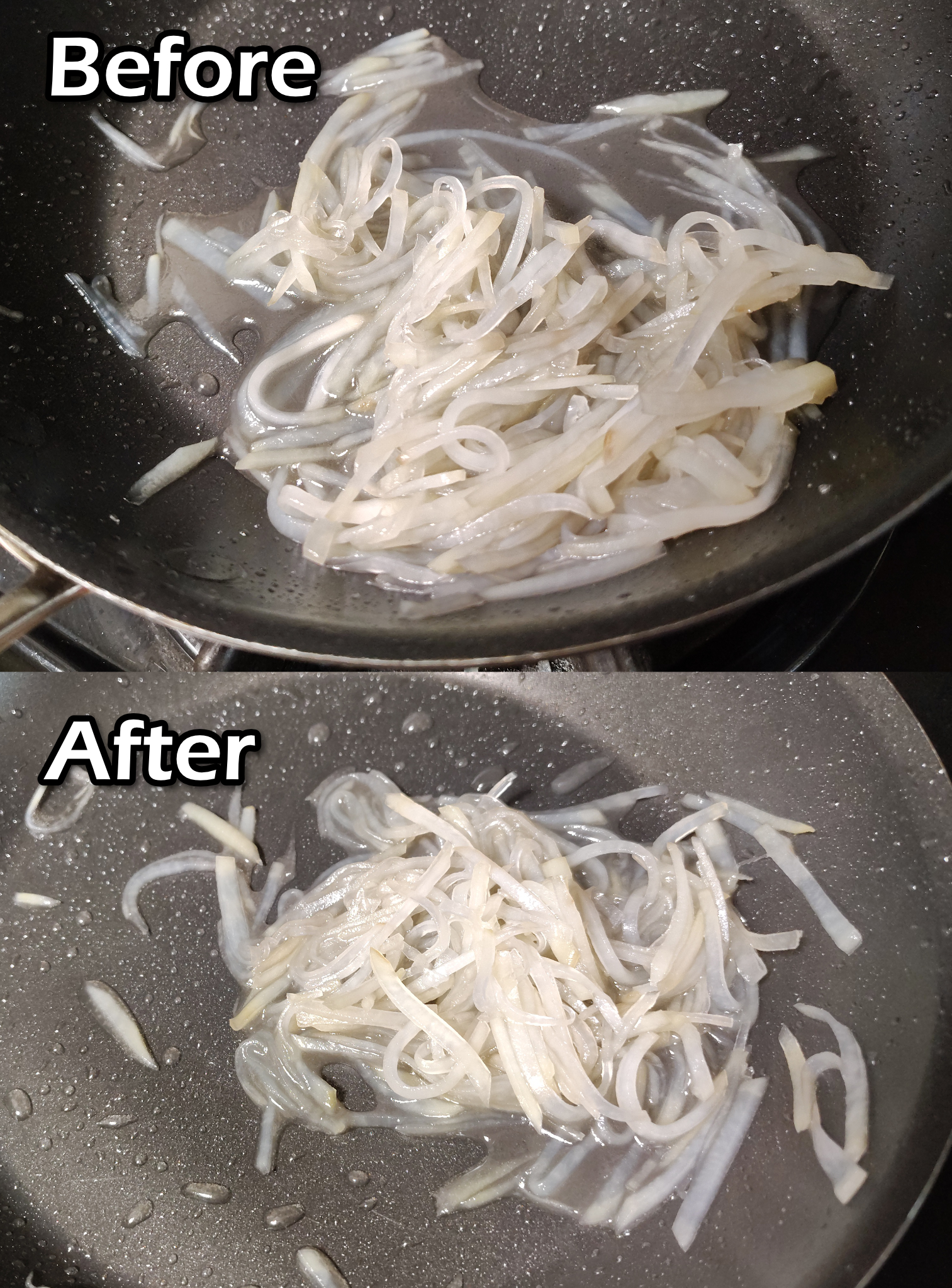
After that, just transfer the cooked imonamasu into a bowl, including the liquid, and let cool before serving.
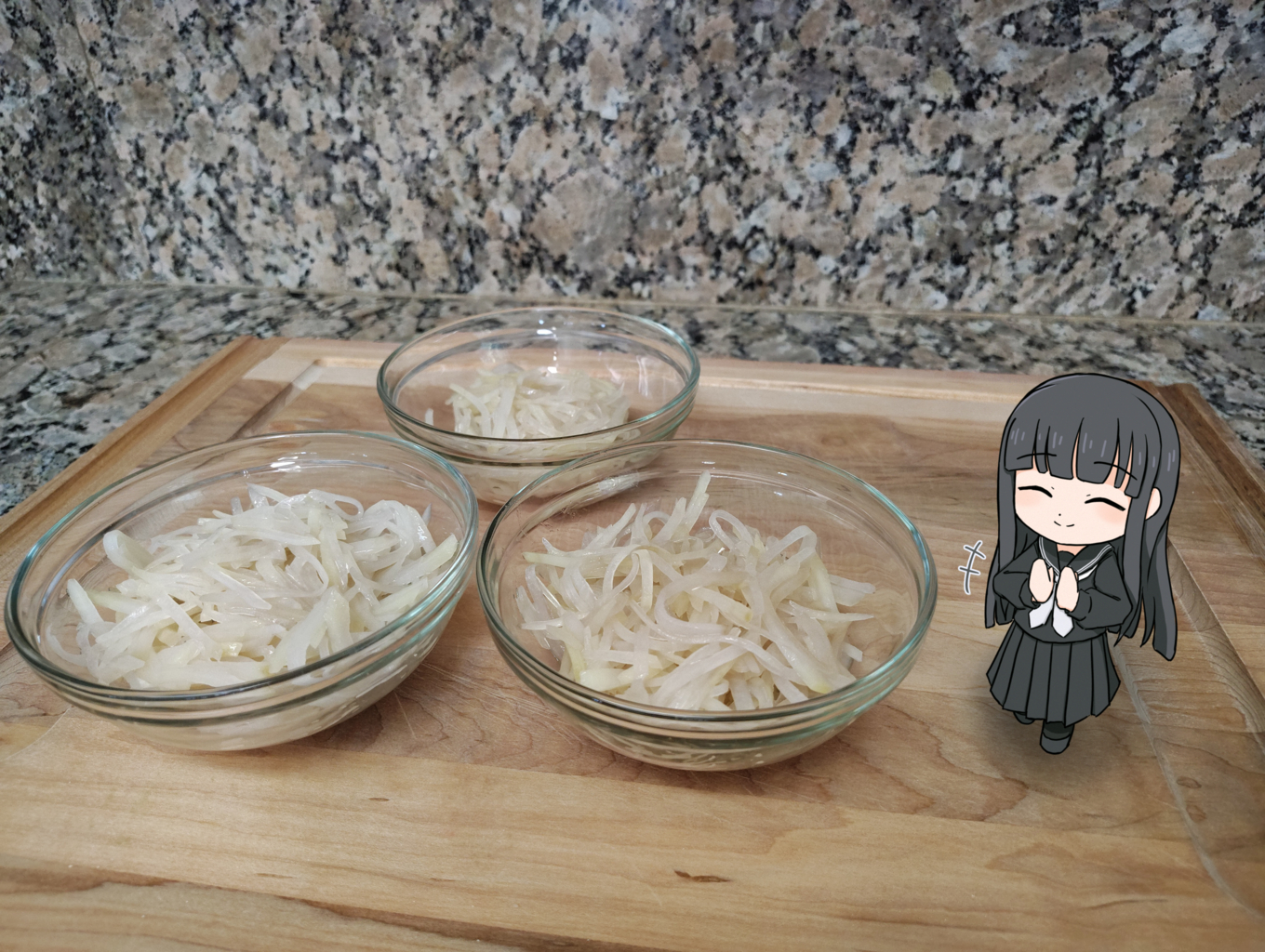
Alright, now that we’re done cooking, it’s time for the taste test to begin. We’ll have our assistant help us out here too, of course! Sachi-san, could you start us off with the vinegar recipe, please?
Sachi: "Of course!" *munch munch*
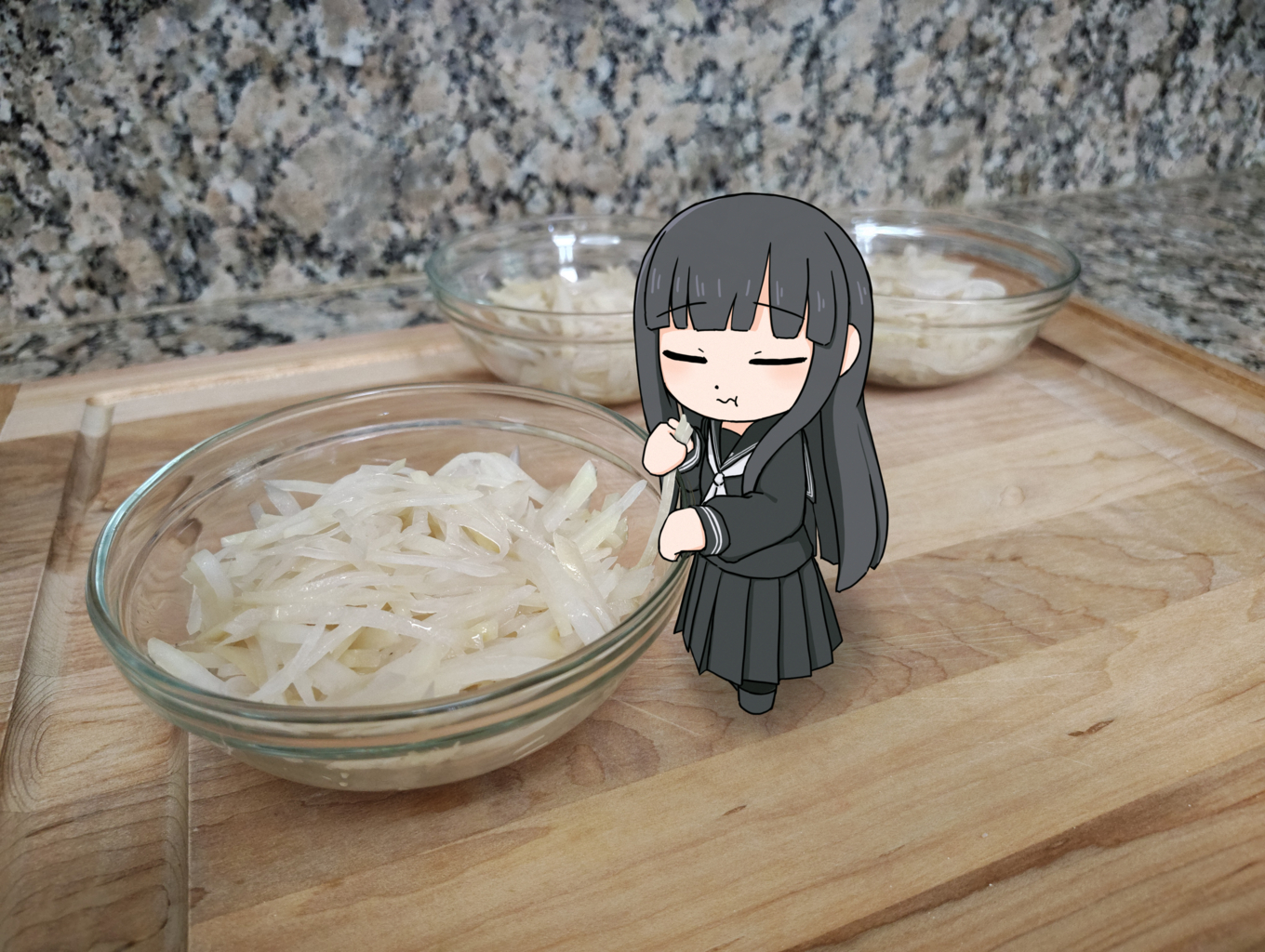
Sachi: "Oh! ...Hmm... this is quite... Quite... hm."
Quite... what, exactly? Well, let me give it a taste, too...
Whoa, that’s vinegary! There’s supposed to be sugar in this, right? I can’t even taste it...
Sachi: "Ah, yes... I didn’t want to be rude, but the taste is definitely a bit strong, isn’t it? How much sugar and vinegar did we use?"
Um, for this one, 1 tsp sugar to 1 tbsp vinegar. So 1 part sugar to 3 parts vinegar.
Sachi: "Oh my, no wonder it’s so sour. I heard from Yuna-san that pickled dishes like this usually use a surprising amount of sugar, but most of it’s meant to balance out the sourness of the vinegar. With this much vinegar, it’s not surprising that you can’t taste the sugar at all."
Yeah, I was expecting this one to kinda be like your typical pickled vegetables, while the others were leaning more toward the sweet side, but now I’m not so sure... Anyways, this one’s a hard pass for me. I’m a fan of pickles and all, but with this, you just get hit immediately by the vinegar and can’t taste much else. I’d like to describe the texture of it, but I’m not sure I can stomach eating any more...
Sachi: "Well, even with the sourness, I think the crispness of the potato still shines through—it’s nice and satisfying. It’s a shame that the vinegar really covers up the taste of the potato, though. Maybe this kind of vinegar-forward seasoning might be better if it was used for something with a stronger flavor instead? Like the daikon in kohaku namasu, for example. Even still, I do think the vinegar here is a bit... much."
Yeah, this one definitely doesn’t leave the greatest first impression—thankfully, the other ones have a lot more sugar, so I’m hoping they’ll turn out better. As for kohaku namasu, that’s the shredded carrot and daikon dish they serve during New Year’s, right? Anyways, let’s move on to the next dish.
Next up is the sugar-heavy one. This one’s got 2 1/3 tbsp sugar to 1 tsp vinegar, so there’s a lot more sugar in this one. Here, Sachi-san, for you.
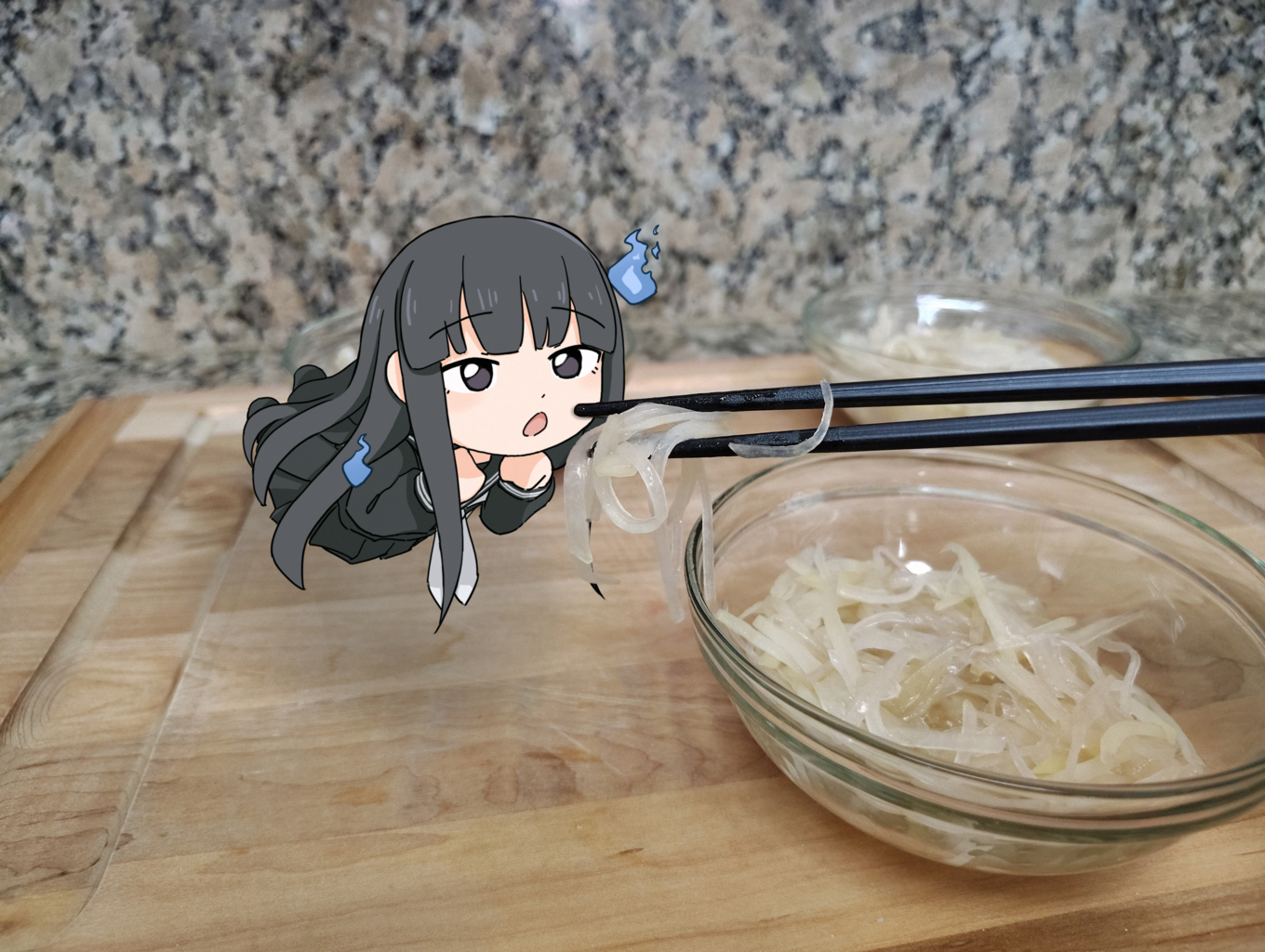
Sachi: "Ahhhh... Mm! Oh, that’s sweet!"
Oh, that’s a lot better than the last one. I could actually eat this!
Now that I can focus on it more, let me describe the texture a bit... It’s like, you can tell that the potato’s still raw, but not in a bad way. It’s got a slight crunch to it, and if I had to liken it to something, I’d say it’s kind of similar to eating bean sprouts? But it’s not really snappy like how bean sprouts are. The crunch is a lot more subtle.
Sachi: "Mhm. The thin cut of it helps give the potato some softness, but the core of it is still kept nice and crisp. I love it!"
The cooking and seasoning also helps remove some of that grittiness and bitterness you’d get from eating completely raw potato, so even though it’s still raw, it doesn’t really taste raw, you know? At first, anyways. You still get some of it in the aftertaste, unfortunately.
Anyways, the texture’s definitely something unique. It’s not the same texture you’d get from eating completely raw potatoes, but it’s far from the typical fluffiness and pillowiness you’d get from cooking it all the way through, like with hash browns.
Sachi: "Hash... browns...? Hash... hash... Hashira Island? It’s not a dish from there, is it?"
Yeah, no... I’m not really sure what place you’re talking about, but they’re definitely not from an island in Japan—I’m not sure where they’re from, actually, but they’re pretty common in the US. As for what hash browns are, they’re, um, thinly shredded potatoes. Kind of similar to imonamasu in that way, I guess. But they’re shaped into patties, and then they’re fried in oil until they’re crispy and cooked through. And they’re seasoned with salt and pepper instead of sugar and vinegar. You see them served for breakfast pretty often.
Sachi: "I see, so it’s imonamasu, but cooked... That’s a bit strange. Wouldn’t cooking the potatoes through make them lose their crispiness? I suppose the frying could help to bring it back..."
Well, I’d say that the frying makes hash browns crispier than just raw potatoes, but it’s a different kind of crispiness than this—it’s drier and oilier, not a raw crunch like the imonamasu here. They're kind of similar to potato chips in that way. Oh, but the texture is still way different from that of potato chips. Anyways, I think we’re getting a bit off track here... What do you think about the taste of this one, Sachi-san?
Sachi: "Hm... It’s tasty, but it’s a lot sweeter than the kind I’m used to. I’m used to the potato’s flavor being the main focus of the dish, and even though it does properly come through here, it does end up being a bit overwhelmed by the sweetness of the sugar."
Well, I don’t mind the initial flavor of it so much, at least in comparison with the first one. It’s very sugar-forward, sure, but it’s not just a single note of sweetness; you can still feel the impact of the vinegar, and like you said, you still get the underlying flavor of the potato as well. I still wouldn’t call it good though—it’s more just okay. The main issue’s just the aftertaste. I can start eating it fine, but once I get a few bites in, the aftertaste starts kicking in, so it gets hard for me to stomach much more after that. It’s kind of weirdly addictive, though; even though I’m not the biggest fan of it, I’m still finding myself reaching for more.
Anyways, now that we’re done with this one, how about we move onto the—
What do you think you're doing with my Sachi-san?!
Oh fuck.
Sachi: "Oh, Megumi! Did you come here to join us?"
Megumi: "Sachi-saaaan! I’ve been looking for you everywhere! And when I finally find you, now there’s this person that’s acting all lovey-dovey with—...! Grr....!"
Sachi: "Now, now, Megumi, it’s alright. We were just tasting these dishes. I’m sorry if you felt left out. But that’s strange, you weren’t invited to join in with us?"
Megumi: "No, not at all..."
Sachi: "Ah, I see... But I suppose she must’ve had her reasons. After all, she doesn’t seem like the type of person to leave people out on purpose."
Ah, um, yeah... it must’ve just slipped my mind. Sorry about that. I’ll be more careful next time.
I can’t tell her that I didn’t invite her because drawing the two of them in these photos would be a lot more effort...
Anyways, now that everyone’s here, Sachi-san and Megumi... um, -san? If you could finish us off with our last one, please. This final one has 1 1/3 tbsp sugar to 1 tbsp vinegar, so it’s a lot more balanced—closer to a 1:1 ratio of both.
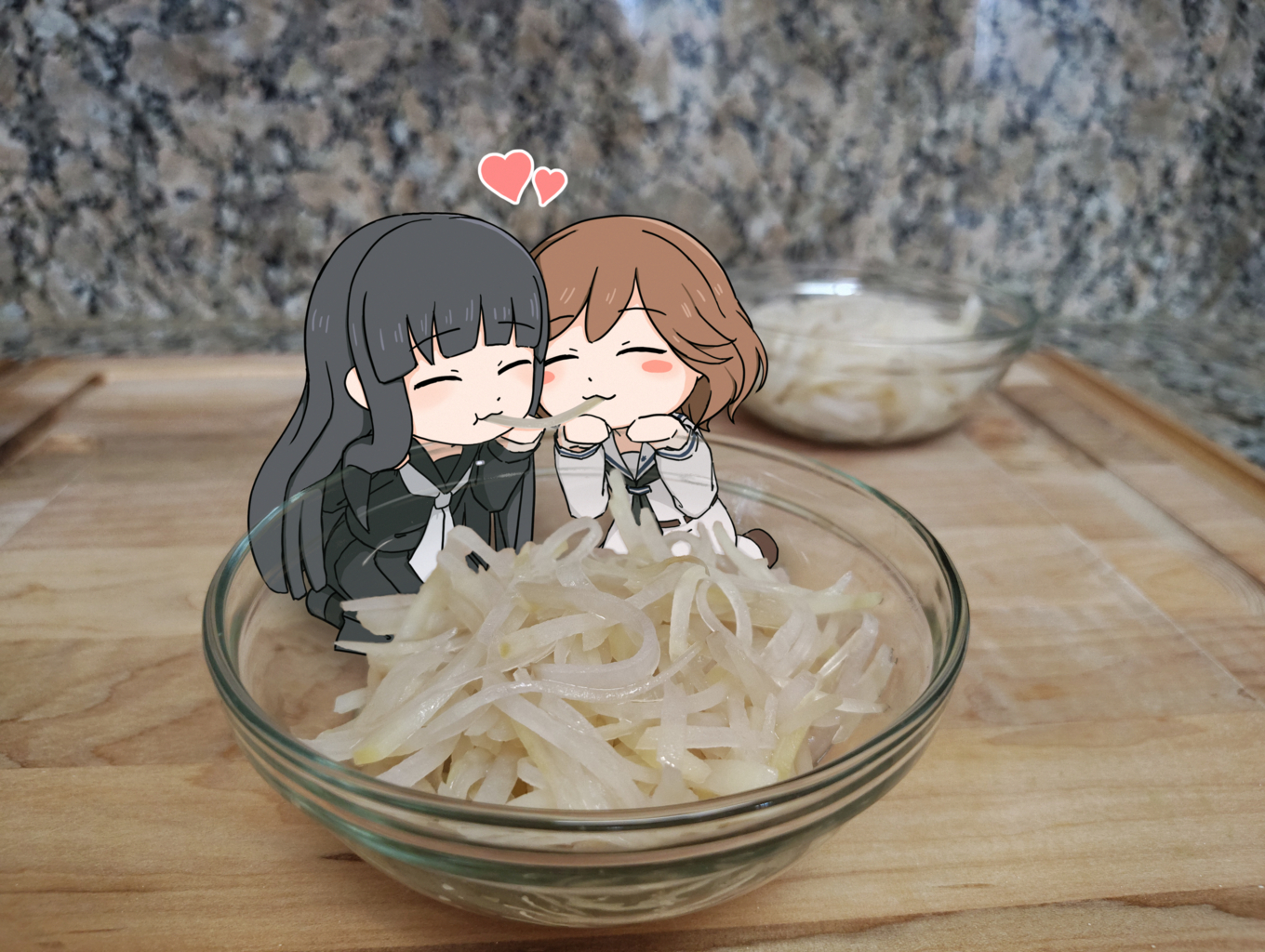
Sachi: "Mmm! This is delicious!"
Megumi: "Mhm!"
Oh wow, that’s actually really good! I was expecting it to be slightly on the sweeter side since there’s more sugar than vinegar in this one, but the vinegar still wins out. You don’t get a strong vinegary punch like the first one, but it’s got a subtle acidity to it that’s just enough to give it that extra oomph of flavor—kind of like when you season something with an extra splash of lemon juice while cooking. Well, even though I said that the vinegar “wins out”, it’s not that you can’t taste the sugar here; you still get some sweet undertones from it even though it's mostly just helping to balance out the vinegar.
Sachi: "Mhm! The subtle flavors of both the sugar and vinegar here make it so neither of them are overwhelming, letting the simple flavor of the potato shine through, and enhancing its flavor just that little bit more. And then, when you bite in, you get that crunch, and... Mmm! The sweet version was nice in its own way, but I think this one’s a lot better."
Yeah, I could see myself happily eating this if it got served as a side at a Japanese restaurant or something. Well... only if it was a small plate of it, though. The flavor was really good at first, but the aftertaste’s starting to kick in now, so it’s kinda hard to stomach any more...
Megumi: "What, you can't handle a little raw potato~? Well, I think it's really tasty! Right, Sachi-san?"
Sachi: "Mhm, I think so too! But anything tastes better when I can eat it with you, Megumi."
Megumi: "Oh, Sachi-saaan~!"
Great, they literally just met up with each other and they’ve already started flirting...
But yeah, I can see why you like imonamasu so much, Sachi-san. There’s still that aftertaste you get, but I’m sure it’s something you’d be used to after you eat this enough. Something of an acquired taste, I guess.
Megumi: "Oh, also, as you keep eating it, it starts changing from a more vinegar-forward flavor to one that’s more sweet! Probably because the sugary syrup at the bottom gets mixed in more, I think? It’s pretty interesting."
Sachi: "Mhm, mixing the syrup in with the potatoes near the end is one of the best parts![4] I’m happy that you were able to pick up on that, Megumi."
Megumi: "Eheheh... And I'm happy that you're happy, Sachi-san~"
Oh my god, please...
※ ※ ※
Anyways, while Megumi’s busy trying the other flavors, what are your thoughts about today, Sachi-san?
Sachi: "I had a lot of fun! It was nice and nostalgic to eat imonamasu for the first time in a while, and I enjoyed being able to help out with the cooking too."
The game takes place in 2012, so it’s been what... 13 years since you’ve had it last? I’d say that’s a lot longer than a while... But talking about helping out, I’m curious... Did you ever try helping Yuna out with her cooking too? I mean, given she’s basically a pro chef, I’m not sure how much help she’d need, but you could at least use your poltergeist tricks to help stir stuff while she’s busy with other stuff, no?
Sachi: "Well, the cafeteria’s in the Hoshikan building, so I wasn’t able to go in there..."
Oh, right.
Sachi: "I did watch Yuna-san through the window while she was cooking during the summer camp, though, and I noticed that she gets really in the zone while she cooks. I don’t have much experience cooking, so even if I could help her out, I’d be more afraid of getting in her way than anything..."
Yeah, I get you. She’s so efficient, it’s actually kind of scary.
I'm honestly pretty jealous of her, even though she’s just a fictional character...
Well, as for me, I’m glad that I was finally able to try some proper imonamasu—or, well, what I think is proper imonamasu. I dunno if the type of potato we used really changes things, so...
Megumi: "Bleeegh! Why’s this one so sour?!"
Sachi: "Well, I don’t think you have to worry about it too much—different people have their own variations on it, after all. Back when I was alive, I remember seeing some people mix in multiple different kinds of potatoes, or even carrots sometimes."[4]
Hm, I guess that makes the difference between russets and danshakus not seem like that big of a deal. The recipes I looked at were all pretty different, after all. We went with the order of さ (砂糖 - “SAtou”, sugar), し (塩 - “SHIo”, salt), す (酢 - “SU”, vinegar) you typically see in Japanese cooking here, but some were saying it’s best if you add sugar at the very end after the vinegar[4], while others were adamant that the sweetness of it wouldn’t stick unless you used it first[6]. Everyone really does have their own approach to it.
Sachi: "Mhm. In other words, there’s not just one answer to everything. Sometimes, you need to find your own answer and believe in it, even if you’re afraid that other people might tell you it’s wrong."
That’s pretty deep... You sure that’s really supposed to be cooking advice, Sachi-san? Well, even if it's actually just disguised dating advice, I suppose potatoes are more related to romance than you'd think. We've seen them work their magic first-hand that one summer, after all...
Megumi: "Sachi-san, I’m back!"
Sachi: "Oh, welcome back, Megumi!"
Well, now that everyone’s here, how about we announce our winners of today’s showdown? Which one did you think was the best, Sachi-san?
Sachi: "The third one was definitely the most delicious! The seasoning was nice and balanced, and it really helps to bring out the natural flavor of the potato. These kinds of Japanese recipes focus more on the simpler flavors of things, so I’m sure it’d be even better if you made it using some high quality potatoes and vinegar."
Megumi: "I liked the second one! It’s sweet, like candy! The third one was good too, but... don’t make the first one. That one’s just gross. You might as well just drink straight vinegar instead."
Well, I wouldn’t really go that far, but yeah, that one was pretty awful... As for me, I don't know if I'd really call any of them great, but the third one was easily the best.
Megumi: "Wait, no fair! How come you get to be together with Sachi-san while I’m alone in choosing the second one?"
We’re literally just ranking potatoes, it’s not a big d—
Megumi: "Fine, I’m changing my answer to the third one, and you have to choose the second one!"
Ugh, whatever. I guess that means two points to the balanced one, one point to the sweet one, and none to the vinegary one. The balanced one wins.
Anyways, we’ve gone over the differences between the flavors plenty already, so there’s not much more to go over there. But regarding the imonamasu itself, I dunno. It’s my first time really eating something like this, and the texture of it was definitely interesting, but even at its best, I don’t think it’s something I’d reach for if I had a choice. Sure, I’d eat it if it was served to me, but I don’t think I’d go out of my way for it.
Sachi: "Oh, that’s a shame... I suppose everyone does have their own opinions on food, though."
Well, I haven’t really eaten much in terms of traditional Japanese food, so it’s probably more just me not being used to this kind of stuff. I don’t really like azuki, konjac, or enoki either.
Megumi: "Whaaat, you don’t like Enoki?! I can’t believe that you’d tell Sachi-san that you hate her, right to her face~!"
Shut uuuup, you know I’m talking about the mushrooms, not her. I bet if I said I liked them, you’d twist that up too and get all jealous instead.
Megumi: "Heh. I totally would."
Sachi: "Now, now, Megumi, there’s no need to tease her so much. But you really can’t handle those kinds of foods, huh? Well, I have seen western food become a lot more common in girls' lunches over the years... I wonder if people’s palates have been starting to shift away from Japanese food."
Well, in my case, it’s more just that I don’t live in Japan... But it is pretty hard to run into proper Japanese food over here. Sure, you'll run into sushi, tempura, or miso soup at just about any Japanese restaurant, but I've only had stuff like hijiki salad or takikomi gohan once or twice when relatives made it for me.
Sachi: "I see. I suppose I shouldn’t be so surprised that you’re not used to Japanese cooking then."
Anyways, regarding the big question of whether you should try making this, I’d say why not? Especially if you’re a Kindred Spirits fan or are just into trying new foods. Definitely don’t make four servings like we did, but other than the soaking, it’s pretty simple and easy to make, so even if you don’t like it, there’s not much to lose here.
Sachi: "It really does only use four ingredients, after all. I’d be happy if you could give it a try!"
But, as for whether I’d make this again, though, I probably wouldn’t. I’d do it all the time for someone as beautiful and lovely as Sachi-san!~♡
Also, what about my carbonara?!
Recipe: Imonamasu
Time required:
- Total time: At least 2 hours
- Rest time: 2 hours to overnight
- Prep/cook time: 15-30 min
Ingredients (for 1 serving (recommended) / for 4 servings):
Basic ingredients:
- 50-75g / 200-300g of any floury potato type available to you (danshaku, russet, maris piper, etc.)
(200-300g is approx. 2 medium danshaku potatoes or 1 medium russet) - 1 tbsp / 3 tbsp neutral cooking oil
For seasoning (pick one of the three):
Balanced[4] (recommended):
- 1 tbsp / 4 tbsp sugar
- slightly more than 1/3 tsp / 1/2 tbsp salt
- 2 1/4 tsp / 3 tbsp unseasoned rice vinegar
Very sweet[6]:
- 1 3/4 tbsp / 7 tbsp sugar
- A pinch of salt
- 1 tsp / 1 1/3 tbsp unseasoned rice vinegar
Vinegary[5] (highly advised against):
- 3/4 tsp / 1 tbsp sugar
- 1/4 tsp / 1 tsp salt
- 2 1/4 tsp / 3 tbsp unseasoned rice vinegar
Also needed:
- large bowl of cold water
- colander
Instructions:
Video reference of making imonamasu, if needed (recipe and order differs, but general steps are the same): https://www.youtube.com/watch?v=R9GJnrohYWM
- Peel your potatoes and trim off the ends of them. Cut a flat spot on each potato to prevent them from rolling while cutting and then cut them into thin slices (width-wise, not length-wise, if using a large potato), approx. the width of about half a matchstick. Stack the cut slices on top of each other and julienne them to the same half-matchstick width, placing the cut pieces into the bowl of cold water as you go.
Note: Using a mandolin for the cutting isn't recommended, as it'll crush the potatoes and make them less crispy. - Rinse the julienned potatoes a few times to remove the starch until the water is clear. Let them soak in the refrigerator for at least two hours (but preferably overnight) to further remove the starch. If soaking for a shorter time, try to change out the water every so often to help remove the starch better.
- Remove the soaked potatoes from the fridge and strain them thoroughly, making sure to shake off any excess water. The potatoes should now be a lighter white color after losing all the excess starch. Avoid leaving the strained potatoes out for too long before cooking, as they'll start to oxidize.
- Add the oil and potatoes to a pan on medium heat. Cook until the potatoes start turning soft and partially translucent, stirring constantly so the potatoes don't brown. You want the potatoes to still be somewhat raw at the end, so be careful not to cook the potatoes all the way through.
(You can set aside one of the sticks of raw potato to keep on hand to make sure the potatoes aren't undercooked, and trying some of the potato every so often while it's cooking can help make sure it's not cooked through.) - Begin seasoning by first adding the sugar and mixing to ensure all the potatoes are coated. Once the sugar melts and the potatoes are all coated, add in the salt, mix the potatoes further until the salt dissolves, and then finally add in the rice vinegar. Continue to stir constantly so the sugar doesn't burn.
- Cook the potatoes just a bit more until the liquid in the pan begins to thicken and take a syrup-like consistency (this is mostly from the sugar, so the vinegar-forward version won't have much). Some liquid is desirable, so don't cook it off entirely; you want to leave some left.
- Transfer the cooked imonamasu into a bowl (including the liquid) and let cool before serving.
Sources
I tried my best to make this recipe (and some of the tidbits) as accurate as possible, so I’m leaving the links to the different sources I used here. Some of the information’s from multiple sources, and some of it’s from my personal experiences, so I haven’t really labeled those, but otherwise, I’ve tried to label any tidbits throughout the article with the sources I used for them.
- Russets as a danshaku substitute: https://nakatomitestkitchen.com/nikujaga/
- Maris pipers as a danshaku subsitute: https://www.reddit.com/r/japanlife/comments/2qhwai/what_kind_of_potatoes_are_suitable_for_mashing/
- Imonamasu video recipe (in Japanese): https://www.youtube.com/watch?v=R9GJnrohYWM
- Balanced recipe/detailed instructions (in Japanese): https://www.iiyama-ouendan.net/special/kyoudoryouri/page01.php
- Vinegary recipe (in Japanese): https://www.oishii-shinshu.net/recipe/recipe-kiso/3643.html
- Sweet recipe (in Japanese): https://cookpad.com/jp/recipes/17448673