



Note: Click the map images to view them full-size! (opens in a new tab)
Sonou-sensei’s Extracurricular Lesson
On Twitter, on top of the weekly K☆R segments held every Wednesday, there were surprise segments to share more information as well.
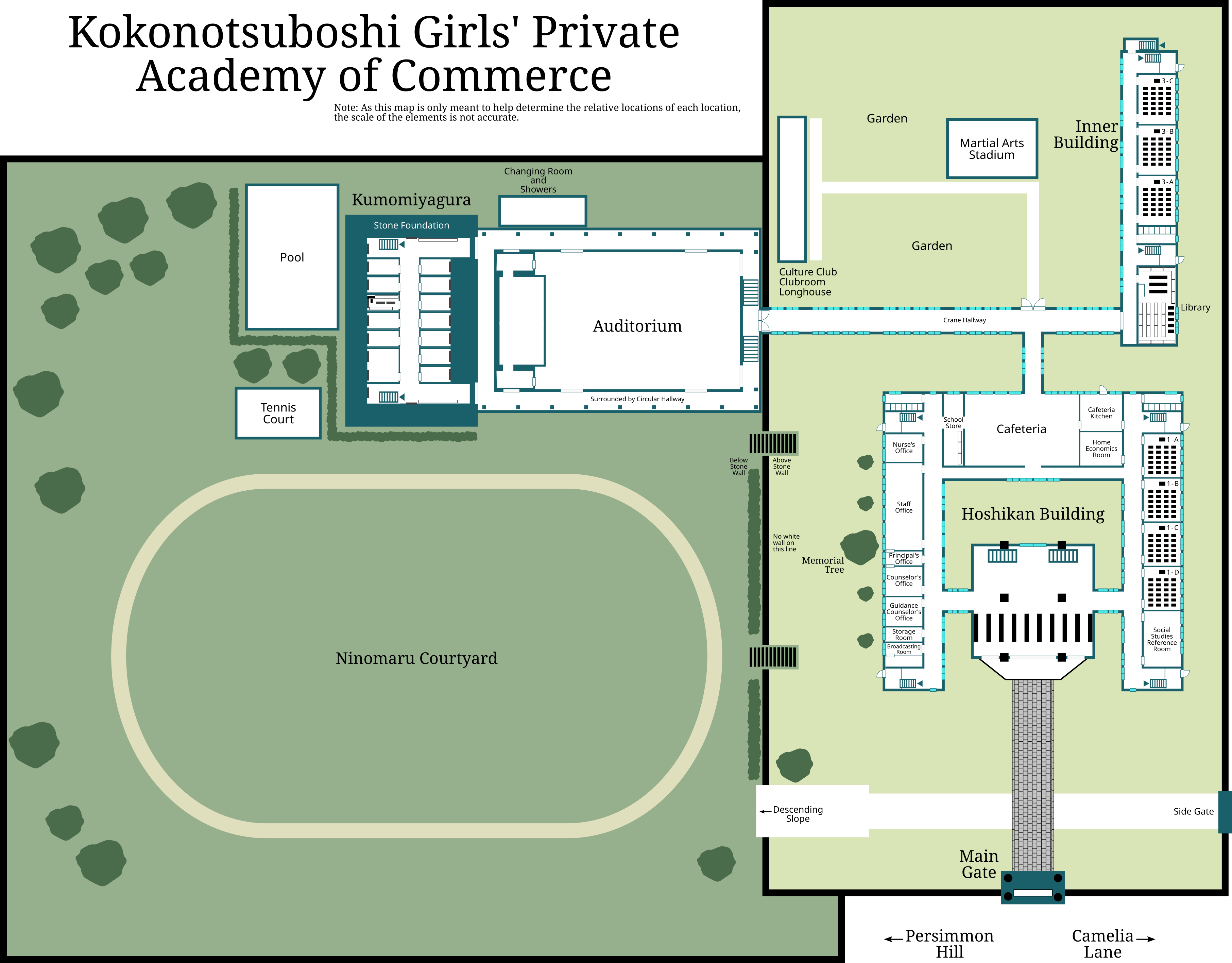
“Sonou-sensei’s Extracurricular Lesson” was one of these segments. We’ve gathered all sorts of things sensei’s taught us here. Please enjoy these lessons alongside a copy of the school map.
About the Castle
Today, we’ll be talking about our dear school.
The official name for the castle our school resides in is the “Nanamine Castle,” meaning “Seven-peak Castle.” There are two theories regarding this name’s origin. The first theory states that its name originated from how the castle overlooked the plains and seven peaks surrounding it, while the second theory states it came from how seven samurai families from the surrounding area came together to build this castle.
The castle is said to have been constructed into its present form with its two walled courtyards and stone wall foundation back during the Azuchi-Momoyama period, which ran from around 1558 to 1600.
Lord Takemiya, who had become the castle’s feudal lord at the time, erected the castle’s stone walls and turned it into a mountain castle with a small main keep.
This school’s managing director, Takemiya-san, is a descendant of Lord Takemiya. He may seem scary at first, but he’s actually quite the friendly gentleman, so be sure to greet him if you happen to see him.
Shirojo’s castle structure
To make things clear for those unfamiliar with Japanese castles, the stone walls on them aren’t like the walls of European castles, which are freestanding and provide a barrier for the structures behind them; rather, they’re more like ramparts that serve as a foundation for the rest of the castle on top, as can be seen in this photo of Himeji Castle:

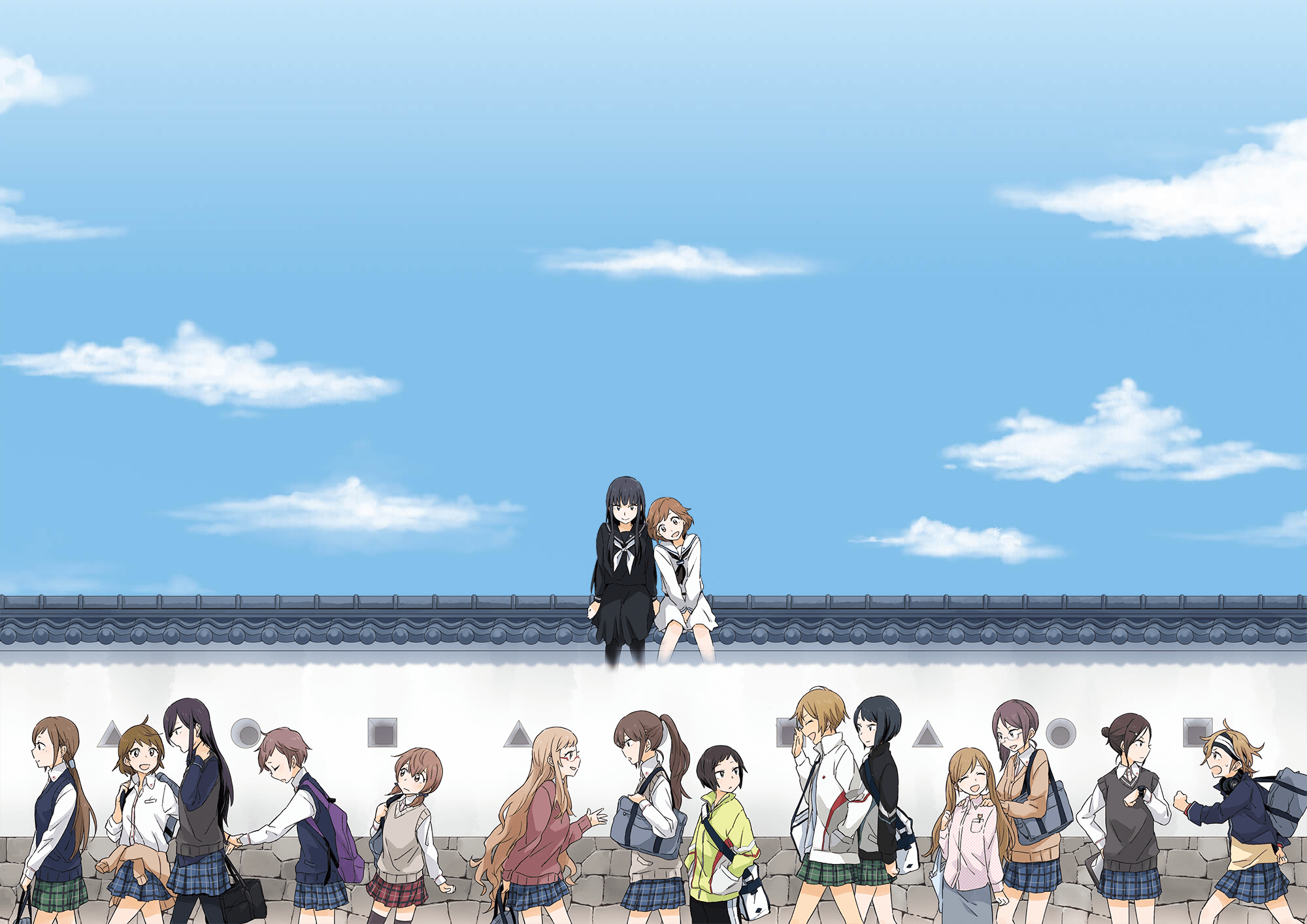
The walls around the courtyards are probably the white walls you can see at the bottom center of the photo, as well as on the title screen art of the game itself:
Given how the layout is described in the school map, I’m assuming the castle’s main courtyard (the honmaru with the Hoshikan and inner buildings) has further stone walls underneath to elevate it from the ninomaru courtyard (with the track and the Kumomiyagura), like you can see with the different elevated areas in the photo of Himeji Castle above.
The school has three gates.
The first gate is the one that everyone here regularly uses, the main gate. The second is the northern gate that leads to the staff parking lot. As for the third one, some of you might not know about it. That one’s the oitatemon, or driving-out gate, a small gate located on the western white wall behind the inner building.
The oitatemon is closed shut with a sturdy lock and bar. Where does it lead, you may ask? Surprisingly, off the side of a cliff.
It turns out that this gate is actually a false gate that was made to drive out demons. Even now, at the start of each year, members of the Takemiya family gather here to open the gate and perform a ritual to drive out demons. I’d like to be able to see it sometime.

Sonou-sensei’s Extracurricular Lesson
About the School’s Clubs
Today, we’ll be talking about our school’s clubs.
At Shirojo, we have about ten athletic clubs and twenty culture clubs. In the past, it’s said there was once a time when we had almost fifty clubs, but in recent times, our club numbers have been on the decline. About half of our school’s students are members of one of our clubs.
Regarding the athletic clubs, we have the track team, kendo club, archery club, swim team, tennis team, badminton team, and more.
The track team is the largest club out of all of them. It seems that most of the students you see exercising around campus are part of it. Komano-san and Kitamura-san really run a lot, don’t they?
Clubs like the soccer club or softball club have their training grounds located outside campus, so when school ends, you can see their members swarming over to their grounds in droves.
Shirojo’s athletic clubs are known throughout the prefecture for ranking above mid-level. Some people attribute that success to Persimmon Hill giving our students’ legs a solid workout on their commute here.
The martial arts area located nearby the inner building is an old, spacious building that was formerly part of the castle. The kendo, judo, naginata, and other such clubs are assigned the space on a daily rotation, and it gets quite lively after school. However, during lunchtime, it’s actually quite empty, so you can find Manomiya-sensei taking naps there.
As for our school’s culture clubs, on top of our most popular club, the drama club, we also have all sorts of fun clubs like the art club, manga club, textile handicrafts club, computing club, English conversation club, and math club. We don’t have a minimum member requirement for our clubs, so as long as you can find a teacher that’ll serve as your advisor, you’re free to start whatever new club you’d like.
But if your club doesn’t actually engage in activities, it’ll end up getting suspended, so I suppose you’ll need some members in your club after all.
Most of the culture clubs’ clubrooms are located inside the building known as the Blue-and-White Flycatcher Longhouse. The building itself is clad in beautiful blue latticework, and the inside of it is divided into large, medium, and small-sized clubrooms. I’m sure those clubrooms are used by very cultural girls to engage in very cultural activities. Probably.
However, there are a number of clubs that have their clubrooms located outside of the longhouse instead.
For example, the light music club uses the garage inside the staff parking lot located outside of the school’s side gate as their clubroom. The girls in the club right now, that um... call themselves a naughty visual kei band, I think? ...have got quite the wild fanbase.
Shirojo Food Report: The School Store
When it comes to Shirojo students’ lunches, there are two main groups of students: those that buy their lunch at school, and those that bring their lunch from home. The buy-at-school group is further split into two groups: those that buy their lunch from the cafeteria, and those that buy their lunch from the school store.
The school store group buys their premade bento boxes, bread, and drinks from the school store located at the side of the cafeteria.
During lunchtime, both a bakery and a bento store set up shop at school, but they’re well-known for getting very crowded. They bring a lot of inventory to school, so make sure to go and buy your lunches calmly without rushing.
At the bakery, not only do they stock your usual sweet breads, they also have sliced bread for sale, starting from just a single slice.
They also stock various types of locally-produced-and-renowned jams as well.
I sometimes spot Umi-san and Sasa-san trying out weird jam combinations together, but their experiments never seem to work out well for them. By the way, my personal favorite is their marmalade. Tsurugimine-san seems to think their strawberry jam is cute.
If we’re talking about items sold at the school store, there’s also the ice cream. It’s one of the few sweets you can buy at our school, so it’s a popular dessert among the girls here.
On top of the store’s freezer, there’s a box used to collect votes for the student-run ice cream popularity poll. These votes are counted every month, and the school store uses the popularity of each flavor to determine how much inventory of each flavor to order. Thanks to this, the store freezer has quite a variety of flavors that change over time.
Strangely enough, a member of the disciplinary committee is apparently the one responsible for managing this poll.
Shirojo School Report: The Cafeteria
The cafeteria, located on the first floor of the Hoshikan building, is the liveliest spot at school.
Because people use the space to chat or catch up on their studies, it’s never empty. But of course, it gets the most crowded during lunchtime. It’s not uncommon for a line to form in front of the food ticket counter.
The cafeteria has about 15 dishes on their regular menu, including udon, soba, and set meals of meat and fish. The cafeteria staff put their hearts into making these meals for us all.
There are different daily and seasonal menu items in rotation on top of the regular menu, so you’ll never get tired of eating here.
The most popular menu item as of late is the omurice plate “Boob Plate A”. You can get an omurice with fluffy egg for just 300 yen. If you want more rice, you just ask for a different cup size. ...It’s a bit embarrassing to go up to the counter and ask for something like a D cup, though.
※ Lecture Supplement: The “Boob Plate” originally made its debut in the Kindred Spirits’ order bonus drama CD, “Kyusei Radio Episode 0”. The pervy head of the cafeteria came up with the item as part of a new, excellently nutritionally balanced menu. The name of the dish comes from the shape of it.
Additionally, from the afternoon to 5 pm, the cafeteria hands out drinks at no charge, at the generosity of the cafeteria’s head, Anzusato.
Their black tea and coffee, which they’re particular about, is quite delicious, and Sensei comes to the cafeteria to drink it often. I often see Ariu-san frequenting the cafeteria around this time as well, taking a break while drinking some black tea. She’s quite the mature-looking girl, so the sight of her sipping from a teacup strangely suits her. I’m a bit jealous.
Talking about after-school cafeteria regulars, there’s also Ano Fuji-san. I often see her there chatting with her clubmates or playing games. She's got quite the social circle, so you see many different girls coming and going around her. I personally think that the fact she’s able to eat so much without gaining weight is one of Shirojo’s seven mysteries.
About the Summer Camp
This time, we’ll be talking about the summer camp. It’s one of Shirojo’s traditions that lets you stay over at school during the summer break.
Although it’s common for students to think that you need to be in a club to participate, you can actually participate without a club as long as you can round up a group of three or more people. Third-year students sometimes group up together to have a study session during the camp.
Lodgings for the camp are assigned based on the number of people in the group and the length of the stay.
For example, as the track team’s quite large, they would be assigned the large rooms in the Kumomiyagura, while a club like the broadcasting club would be asked to stay in their clubroom. Some clubs choose to go with more unconventional accommodations, though. For example, the drama club sleeps in tents they pitch up in front of the clubroom longhouse. Doesn’t it get too hot over there, though? Are they okay?
As a rule, meals for the camp are left in the hands of the students or their guardians.
The cafeteria staff do take turns to supervise the cooking facilities, but they rarely provide actual cooking advice. In the words of Anzusato-san, “No matter how good or bad the meals turn out, they both make good memories in the end.”
At the end of each day, each group of participants or their representative must provide a report on the activities they’ve performed that day. The camp’s still part of school, after all, so that much is to be expected. And Sensei loves reading everyone’s reports. Please make sure to turn them in early.
For bathing, students use the shower room located at the side of the auditorium. Use of the large bathroom is assigned through timeslots on a per-group basis. The group assigned the first timeslot is also allowed to choose what bath salt is used in the bath, so it’s a bit of a bonus for them.
Cleaning of the bathroom is done on rotation by the different athletic clubs. It seems like hard work, but the club in charge of cleaning the bathroom is also allowed to choose the bathing timeslot they’re assigned.
The swim team’s especially quick with their cleaning, getting it done in their swimsuits before they head off to practice.
During the camp, lights out is at 11 pm, and students are generally forbidden from going outside after this time. However, each group is assigned a day where they’re allowed to perform a test of courage, and they’re allowed to go out at night on that day only.
A popular route for the test is the path leading from the side of the staff parking lot to the stone monument. It really does get dark there, so please be careful while you’re having fun.
For more details, please check the summer camp handbook.
Let’s all live a fun and worthwhile summer!
About the Graduation Ceremony
Rise, bow, take a seat.
Today, we’ll be talking about the graduation ceremony which just took place the other day.
The graduating students wear hakama to the graduation ceremony.
Sets of hakama are lent out to each graduating class by the school. When February starts and the hakama fittings start taking place, it really makes you realize that graduation is drawing close. Girls are each given either a Japanese plum or peach corsage to wear on their chest.
The day of the ceremony. The third-years come to school in their uniforms and change into their hakama at the Kumomiyagura.
Non-graduating students who know how to put on a hakama are allowed to help out with the preparations, so there are sometimes some students mixed in who’ve only learned how to put on a hakama to get the chance to touch the senpai they admire. The prep period gets quite lively, and it’s known for having some kind of trouble every year.
The ceremony itself is quite orthodox.
Non-graduating students are free to attend the ceremony as they please, with many of those students tending to be other club or committee members. Students wishing to attend the ceremony must do so in uniform. This is the first time I’ve seen Komano-san in her uniform in quite a while. The sight of her really took Tsurugimine-san by surprise.
After the ceremony, the graduating students change back into their uniforms and head to their classrooms. There, they have their final homerooms before they finally leave the nest. Students take all sorts of commemorative photos around the school during this time.
The most popular spot for those photos would probably be in front of the main gate. Amishima-san was getting so many requests for photographs that there was a line forming just to take one with her.
As a teacher, this was my second time going through the ceremony and seeing my students off.
I was able to make it through the ceremony just fine at the time, but after I got back home and took a breather, a wave of emotions really came over me.